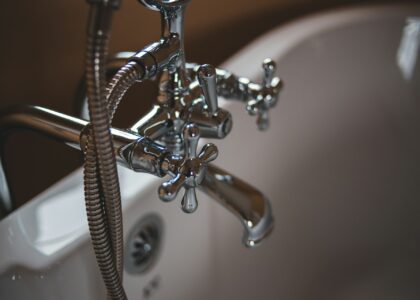
That slow drip from your bathroom faucet has been going on since January. You barely noticed it during the deep freeze, too busy worrying about whether your pipes would survive another -35°C night, but now that March has rolled around and the chinooks are giving us those teasing afternoons above zero, that drip is suddenly impossible to ignore.
Here’s the thing: a faucet dripping once per second wastes over 11,000 litres of water per year. On Calgary’s water and wastewater rates, that’s roughly $50 to $70 tacked onto your annual utility bill for absolutely nothing. And that’s just one faucet. If your toilet is running intermittently, that phantom flush you hear at 2 a.m., you could be losing another 750 litres a day.
So when do you fix what you’ve got, and when do you rip it out and start fresh? After years of handling bathroom plumbing across every Calgary neighbourhood from Kensington bungalows to Cranston duplexes, here’s the honest breakdown.
The “Repair It” Scenarios: When Your Existing Fixtures Still Have Life
Not every drip means a trip to the plumbing aisle at Home Depot on Macleod Trail. Some problems are straightforward fixes that a skilled handyman can knock out in under an hour.
Leaky Faucets
The vast majority of bathroom faucet leaks come down to one of three culprits: a worn O-ring, a degraded cartridge, or mineral buildup from Calgary’s notoriously hard water. Our municipal water supply measures between 11 and 16 grains per gallon of hardness, that’s “very hard” by any standard, and it takes a real toll on faucet internals over time.
When repair makes sense:
Your faucet is less than 8-10 years old, the body and finish are in good shape, and the leak is coming from the handle area or spout. A cartridge replacement on a single-handle Moen or Delta faucet typically runs $150 to $250 CAD in Calgary, including parts and labour. That’s a fraction of a full replacement and buys you another 5-7 years easily.
The calcium factor: If you’ve got visible white crusty buildup around the aerator or handles, that’s calcium carbonate from Calgary’s hard water. A good handyman will soak the components in a vinegar-based descaler during the repair, it’s a small detail that makes a massive difference in how long the fix lasts.
Running Toilets
That phantom flush, where your toilet seems to randomly refill itself every 20 minutes, is almost always a deteriorated flapper valve. It’s a $15 part. The labour to diagnose and replace it properly (including adjusting the chain length and checking the flush valve seat for corrosion) runs about $100 to $175 CAD in Calgary.
Other common toilet repairs and their typical costs:
The fill valve is another frequent offender. When your toilet takes forever to refill or makes a high-pitched whine after flushing, the fill valve assembly usually needs replacing. Budget $125 to $200 CAD for parts and labour. A wobbly toilet that rocks when you sit down often just needs new wax ring and closet bolts, a $150 to $225 CAD fix that also prevents water from seeping under the base and damaging your subfloor (something we see constantly in older homes in communities like Mount Royal and Hillhurst where original flooring meets decades-old plumbing).
When repair makes sense: Your toilet is a standard model less than 15 years old, the porcelain is in good condition (no cracks, no staining that won’t come clean), and the problem is mechanical, not structural.
The “Replace It” Scenarios: When It’s Time for an Upgrade
Sometimes throwing money at repairs is like patching a tire for the fourth time. Here’s when replacement is the smarter long-term call.
Faucets Past Their Prime
Replace when:
Your faucet is 12+ years old and you’re dealing with recurring leaks. At that age, it’s not just the cartridge, the valve seats wear down, the body can develop hairline cracks (especially in cheaper zinc-alloy models), and replacement parts become harder to source. If your plumber is telling you “I’ll have to order that part,” that’s often a signal the model is approaching end-of-life.
Corrosion underneath the faucet body is another dealbreaker. Pull up on your faucet, if it wiggles or you see green oxidation on the mounting hardware underneath, water has been seeping into places it shouldn’t. In Calgary’s dry winter air (indoor humidity can drop to 15-20% without a humidifier), the constant cycle of dry conditions and wet fixture creates accelerated corrosion on cheaper metals.
What replacement costs in Calgary (2026):
A quality bathroom faucet replacement, including a mid-range fixture from Moen, Delta, or Pfister, plus professional installation, typically runs $400 to $700 CAD. That covers removal of the old unit, checking supply line connections for wear (critical after a Calgary winter), installing the new faucet, and testing everything. If your supply lines are the old braided-steel type and show any signs of corrosion, replacing those at the same time adds $50 to $100 but prevents the nightmare scenario of a supply line bursting while you’re at work. We’ve seen it happen in Signal Hill, Tuscany, and newer communities in the deep south, the damage from even a few hours of water flow can easily hit $10,000 to $20,000 in restoration costs.
For higher-end fixtures, touchless models, matte black or brushed gold finishes, or wall-mounted units, budget $700 to $1,200 CAD installed.
Toilets That Need Retiring
Replace when:
Your toilet uses more than 6 litres per flush (6 LPF). If your home was built before 2009 and the toilet is original, there’s a good chance it’s using 13 LPF or more, that’s literally double the water of modern models. At Calgary’s current water rates, upgrading a single high-flow toilet to a modern dual-flush unit saves roughly $80 to $120 per year. The toilet pays for itself in 5-7 years, and you get a better flush in the process.
Cracked porcelain is a non-negotiable replacement trigger. Even hairline cracks can harbour bacteria and will eventually leak. Calgary’s frost-heave cycles put stress on bathroom floors, and toilets bolted to a shifting subfloor can develop stress fractures at the base over years.
Persistent clogs that don’t respond to plunging often indicate a problem in the trapway. Older toilets with smaller trapways (the internal channel the water flows through) simply can’t handle modern toilet paper and, well, modern diets. Newer models have significantly wider trapways, the difference in day-to-day reliability is night and day.
What replacement costs in Calgary (2026):
A standard toilet replacement, including a quality model like the American Standard Cadet or Kohler Highline, removal and disposal of the old unit, new wax ring, supply line, and installation, runs $650 to $1,100 CAD. Dual-flush models that let you choose between 3 LPF and 4.8 LPF sit in the same range and are increasingly popular with Calgary homeowners who are conscious about water usage.
For wall-hung toilets or smart toilets (heated seats, bidet functions, self-cleaning), you’re looking at $1,500 to $2,900 CAD installed, depending on whether in-wall carrier modifications are needed.
A Real Example: The McKenzie Towne Half-Bath Overhaul
Last fall, a homeowner in McKenzie Towne called us about a leaky bathroom faucet in their powder room. The faucet was a builder-grade model from 2012, chrome finish peeling, persistent drip from the spout despite a cartridge replacement two years prior. The toilet was original too: a 13 LPF single-flush that needed two flushes every time.
We gave them two options:
Option A (Repair): Replace the faucet cartridge again and swap the toilet flapper. Estimated cost: $275 CAD. Likely lifespan of fix: 1-2 years before the same issues return.
Option B (Replace both): New Moen Genta single-handle faucet in brushed nickel plus a Kohler Highline dual-flush toilet. Total cost: $1,450 CAD.
They went with Option B. The water bill dropped $14 the very next month. The room looks completely refreshed, guests actually comment on it. And they won’t need to think about that bathroom’s plumbing for another decade.
That’s the math that makes replacement worth it when you’re dealing with aging fixtures.
Calgary-Specific Considerations Most Plumbers Won’t Tell You
Hard Water Is Your Faucet’s Worst Enemy
We mentioned Calgary’s hard water earlier, but it deserves emphasis. That 11-16 grains per gallon hardness means calcium deposits build up inside your faucet cartridges, on your aerator screens, and inside your toilet fill valves faster than in most Canadian cities. If you don’t have a water softener, expect to replace cartridges and internal components 30-40% sooner than manufacturer estimates suggest. A whole-home water softener ($2,500 to $4,500 CAD installed) pays for itself in extended appliance and fixture life if you plan to stay in your home long-term.
Post-Winter Inspection Is Critical
March is the perfect time to check your bathroom plumbing because winter does real damage that isn’t always visible. Those -30°C stretches put thermal stress on pipe joints and supply connections. When things warm up, especially during a chinook swing where outdoor temps jump from -20°C to +10°C in a matter of hours, that’s when weakened joints start to seep. Check under every bathroom vanity for moisture, staining, or that musty smell that signals a slow leak.
Alberta Building Code and Permits
Straightforward faucet and toilet replacements don’t require a permit in Calgary. However, if your replacement involves moving supply lines, adding new shut-off valves where none exist, or modifying drain connections, you may need a plumbing permit from the City of Calgary’s Planning & Development department. This comes up most often in older homes in communities like Inglewood, Bridgeland, and Ramsay where original plumbing may not have individual fixture shut-offs. A licensed handyman service will know when a permit is necessary and handle the process for you.
How to Choose the Right Fixtures for Calgary Homes
When selecting replacement faucets and toilets, keep these Calgary-specific tips in mind.
Go with ceramic disc cartridges in faucets, they resist hard water buildup far better than rubber-washer designs. Moen’s Duralast cartridge and Delta’s Diamond Seal are both excellent options that hold up well in Calgary’s water conditions.
For toilets, prioritize MAP (Maximum Achievable Performance) scores of 800 grams or higher. This testing standard measures how much solid waste a toilet can clear in a single flush. Anything above 800g means you’re getting a toilet that actually works, not just one that meets the minimum code requirement.
Choose finishes that resist water spots, brushed nickel, matte black, and PVD (Physical Vapor Deposition) finishes hide Calgary’s hard water spots far better than polished chrome, which shows every single droplet.
What to Do Next
If you’ve been living with a dripping faucet, a running toilet, or fixtures that look like they belong in a different decade, spring is the ideal time to address it. The post-winter window, before you’re thinking about deck season, landscaping, and exterior projects, is when most plumbers have the best availability and you can actually get same-week service.
At Great Canadian Handyman, we handle bathroom faucet and toilet repairs and replacements across every Calgary community, from established neighbourhoods like Brentwood and Bel-Aire to newer developments in Auburn Bay and Seton. We’ll give you an honest assessment of whether repair or replacement makes more sense for your specific situation and budget.
Get a free estimate for your bathroom plumbing project: Request Your Free Estimate or call us directly at (587) 672-2022. We’ll get back to you within one business day.
Great Canadian Handyman serves all Calgary communities and surrounding areas including Airdrie, Cochrane, and Okotoks. Licensed, insured, and built for Calgary conditions.