Why Your Calgary Home Has New Drywall Cracks This Spring, And How to Fix Them Right
You noticed it last Tuesday morning. Coffee in hand, sunlight finally streaming through the kitchen window after months of grey, and there it is, a thin, jagged line running from the corner of your ceiling down toward the window frame. It wasn’t there in October. Or maybe it was, and the dark mornings hid it. Either way, it’s staring at you now, and you’re wondering: is my house falling apart?
Take a breath. You’re not alone, and your house is almost certainly fine. Every spring, Calgary handymen field hundreds of calls about new drywall cracks, and the explanation is both simpler and more interesting than most people expect. It comes down to what your home endured over the past five months, and what happens when everything starts to thaw.
What Actually Causes Winter Drywall Cracks in Calgary
Calgary’s climate is uniquely brutal on interior walls, and it has everything to do with extremes. Between November and March, your home experienced temperature swings that would make an engineer wince. Consider what happened this past winter alone: weeks of sustained -25°C to -35°C cold, punctuated by chinook events that pushed temperatures above 10°C in a single afternoon. That’s a 40-degree swing in hours, and your house’s framing, foundation, and drywall felt every degree of it.
Here’s what’s happening behind your walls. Wood framing expands and contracts with moisture and temperature changes. Your home’s foundation shifts slightly as the frost line moves, in Calgary, that frost line can penetrate 1.2 to 1.8 meters deep depending on the winter. When the ground freezes, it pushes upward (frost heave). When it thaws, everything settles back. Your drywall, which is rigid gypsum sandwiched between paper, can’t flex with all that movement. Something has to give, and it does, as cracks.
Then there’s the humidity factor. Calgary winters are legendarily dry. Indoor relative humidity in most Calgary homes drops to 15-20% between December and February, even with a humidifier running. That dry air sucks moisture out of drywall and wood framing, causing them to shrink. When spring arrives and humidity climbs back to 35-45%, everything swells again. The result? New cracks, reopened old cracks, and the occasional nail pop that seems to appear out of nowhere.
The Five Types of Drywall Cracks Calgary Homeowners See in Spring
Not all cracks are created equal. Understanding what you’re looking at helps you decide whether it’s a weekend DIY fix or something that needs professional attention.
1. Hairline Settlement Cracks
These are the most common by far. Thin lines, usually less than 1mm wide, that appear at the corners of door frames, window frames, and where walls meet ceilings. They follow the drywall tape joints. Nearly every Calgary home develops these over time, and they’re almost always cosmetic. Homes in newer communities like Cranston, Auburn Bay, and Livingston tend to see more of these in their first five years as the house settles into its foundation.
Fix difficulty: Easy DIY or quick handyman repair. Costs $150-$300 CAD for a professional to address several cracks in one visit.
2. Nail Pops
You’ll see a small circular bump or crater in your wall or ceiling where a drywall nail or screw has pushed through the surface. This happens when the wood stud behind the drywall shrinks or shifts, and the fastener stays put while the wood moves away from it. New construction homes in communities like Tuscany, Sage Hill, and Seton are particularly prone to nail pops during their first three winters.
Fix difficulty: Easy DIY. A handyman can knock out a dozen nail pops in under an hour. Expect $125-$250 CAD for a service call covering multiple nail pops.
3. Tape Joint Cracks
These follow the seams between drywall sheets, long, relatively straight lines running horizontally or vertically. They indicate that the paper tape and mud at the joint has separated, often due to repeated expansion and contraction cycles. Calgary’s chinook cycles accelerate this type of failure because the rapid temperature swings cause more dramatic movement than a city with stable cold winters.
Fix difficulty: Moderate. Requires re-taping and proper feathering of joint compound. This is where DIY often goes sideways, visible seams after repair are the number-one complaint we hear from homeowners who tried to fix it themselves. Professional repair runs $200-$500 CAD depending on the length and number of joints.
4. Stress Cracks Above Doors and Windows
Diagonal cracks radiating from the upper corners of door frames and windows are stress cracks. They form because openings in walls are natural weak points, the weight of the structure above the opening creates stress that concentrates at the corners. In Calgary, frost heave can amplify this by shifting the load paths slightly each winter.
These are usually cosmetic, but if the crack is wider than 3mm or the door/window has become difficult to open or close, it could indicate foundation movement worth investigating.
Fix difficulty: Easy to patch, but they’ll often come back unless the underlying movement stabilizes. Professional repair: $150-$400 CAD. If recurring, a foundation assessment ($300-$600 CAD) is worth considering.
5. Ceiling Cracks (The Scary-Looking Ones)
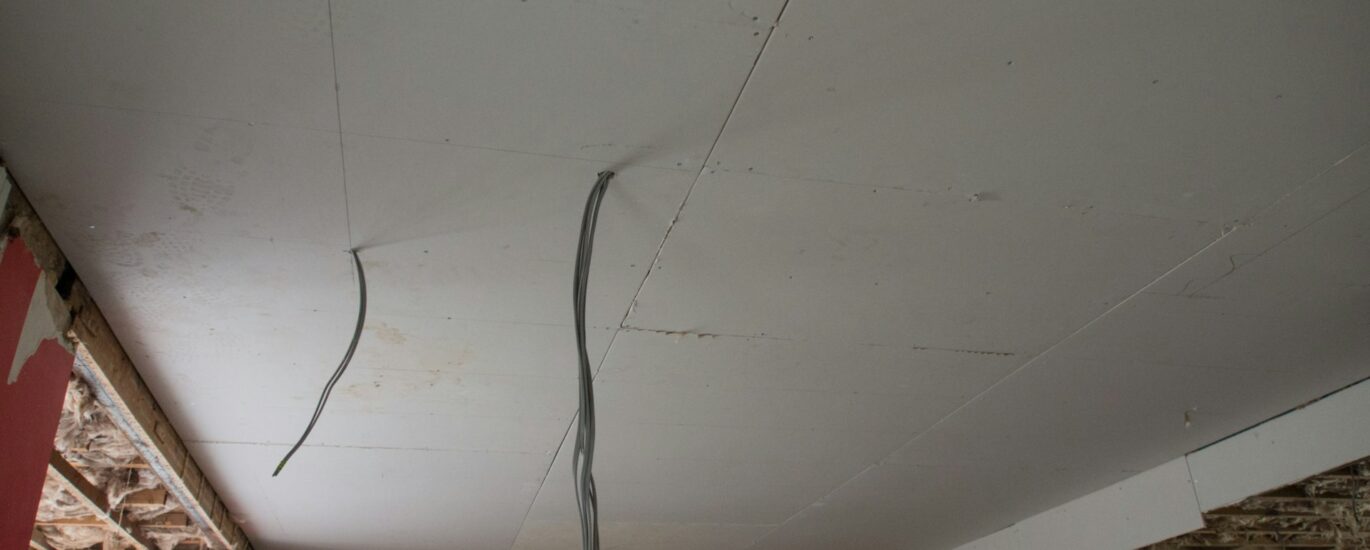
Long cracks running across a ceiling can look alarming, but they’re usually caused by truss uplift, a phenomenon where the bottom chord of a roof truss lifts slightly during winter as the top chord shrinks in the cold. This pulls the ceiling drywall upward at the center of the span, creating a crack where the ceiling meets the interior partition walls. It’s common in Calgary homes built since the 1980s and is almost always cosmetic.
Fix difficulty: Moderate to tricky. The standard fix involves installing crown molding or a floating drywall clip system that allows movement without cracking. Professional ceiling crack repair typically costs $300-$700 CAD.
When a Crack Is More Than Cosmetic: Red Flags to Watch For
Most spring drywall cracks in Calgary are cosmetic nuisances. But some deserve immediate attention. Call a professional if you notice any of the following.
Cracks wider than 5mm, or any crack that’s visibly growing week over week, could indicate active foundation movement. Horizontal cracks in basement walls are a different category entirely, these can signal hydrostatic pressure against your foundation and should be evaluated promptly, especially during spring thaw when Calgary’s water table rises.
Cracks accompanied by sticking doors or windows suggest the house is shifting enough to distort the frames. This is more common in older communities like Mount Royal, Elbow Park, and Britannia, where homes sit on clay-heavy soils that expand and contract dramatically with moisture changes.
Water stains around or near cracks indicate moisture infiltration. Before you repair the drywall, you need to find and fix the water source. Spring snowmelt and ice dam damage are frequent culprits in Calgary, if you see a brown or yellowish stain accompanying a ceiling crack, check your attic for ice dam evidence before patching anything.
Finally, any crack in a load-bearing wall that’s accompanied by a sagging floor or ceiling above should be assessed by a structural engineer, not just a handyman. This is rare, but it’s worth mentioning because catching it early can save tens of thousands in structural repairs.
The Right Way to Repair Drywall Cracks (Not the YouTube Way)
Here’s where we see a lot of Calgary homeowners go wrong. The internet is full of drywall repair tutorials, and most of them skip the step that matters most: addressing movement before patching.
If you simply fill a crack with mud and paint over it, you’ll see it again next spring. Guaranteed. The proper repair sequence is different.
First, widen the crack slightly with a utility knife to create a clean channel. This feels counterintuitive, making the problem look worse before making it better, but it gives the repair material something to grip. Next, apply a high-quality fiberglass mesh tape over the crack. Paper tape is fine for new construction, but for crack repair, fiberglass mesh handles future movement better. Then apply multiple thin coats of setting-type joint compound, feathering each coat wider than the last. Setting compound (the kind you mix from powder) is stronger than pre-mixed compound and resists cracking better. Let each coat dry fully. Sand smooth, prime with a PVA drywall primer, and paint.
For nail pops, the fix is to drive a new drywall screw 50mm above and below the popped nail, then remove the old nail, patch the hole, and finish.
For recurring cracks in the same location, the ones that come back every spring, consider using an elastomeric caulk or a flexible joint compound designed for high-movement areas. These products stay slightly flexible after curing, which accommodates the seasonal movement Calgary homes experience.
What Professional Repair Looks Like (And What It Should Cost)
A skilled handyman can address most drywall crack repairs in Calgary in a single visit. Here’s what to expect for pricing in the current Calgary market.
A standard service call covering 5-10 small cracks, including nail pops and hairline settlement cracks, typically runs $250-$450 CAD. This includes cutting, taping, mudding, sanding, priming, and painting to match. More extensive repairs, multiple rooms, large tape joints, or ceiling work, can range from $500-$1,200 CAD depending on scope.
At Great Canadian Handyman, we include a full visual inspection of all cracks in the home during the service call. We’ll tell you which ones are cosmetic, which ones to monitor, and whether any warrant further investigation. No charge for the assessment when bundled with repair work.
The key thing to look for in any contractor you hire: do they feather their mud properly? A good drywall repair should be completely invisible after painting. If you can see the patch, the work wasn’t done right. Ask for references with recent drywall work, and don’t be shy about looking closely at the finished surface under side-lighting.
Spring Is the Best Time to Fix Winter Cracks, Here’s Why
March and April are ideal for drywall repair in Calgary for a few practical reasons. Indoor humidity is climbing back to reasonable levels, which means the wood framing and drywall are close to their “summer size.” Repairs done now, when the materials are expanded, are less likely to re-crack next winter because you’re patching at the point of maximum expansion. Conversely, repairs done in mid-winter, when everything is contracted, will be stressed as the house swells in spring.
Spring is also when natural light returns to Calgary homes, making it the first time many homeowners notice damage that accumulated over the dark winter months. You’re not imagining it, those cracks really did appear over winter. The good news is that fixing them now means you get to enjoy smooth, clean walls all summer.
Ready to Get Your Walls Back to Perfect?
If you’ve spotted new cracks this spring, you’ve got options. Small hairline cracks and single nail pops are reasonable DIY projects if you’re comfortable with a putty knife and some patience. For anything beyond that, multiple cracks, tape joint failures, ceiling work, or cracks you’re not sure about, a professional repair is the faster, better-looking path.
Great Canadian Handyman serves every Calgary community, from Kensington to McKenzie Towne, Signal Hill to Airdrie. We’ll assess your drywall damage, explain exactly what’s happening, and get your walls looking flawless.
Get a free estimate: Request your drywall repair estimate here or call us at (587) 672-2022. Most drywall repairs can be completed in a single visit.